Teaching resources
Assessing class participation every day, without the overhead
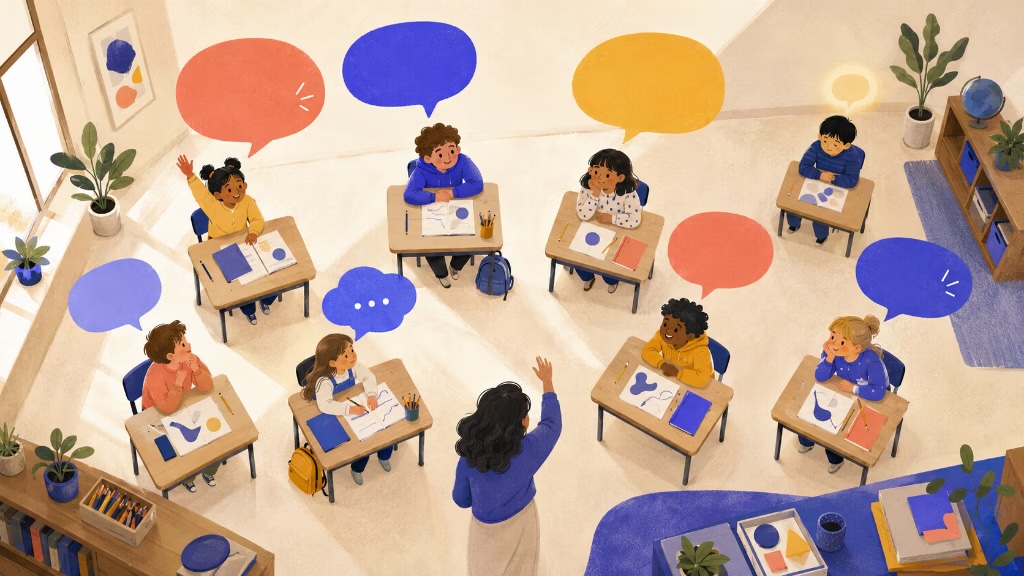
In short — Class participation is one of the hardest things to grade honestly: it's fleeting, unevenly distributed, and our memory favors the students who speak loudest. The answer isn't yet another form to fill in, but three simple habits: clarify what you're assessing, observe often in small touches, and keep a record with a single gesture — so participation becomes a lever for growth, not a surprise grade.
Why participation is so hard to assess
Every teacher knows the end-of-term discomfort: you have to put a comment — sometimes a grade — on the class participation of thirty students, and you realize you're working mostly from impressions. The problem isn't a lack of rigor; it's the nature of the thing itself.
Participation is fleeting: a brilliant remark on a Tuesday in November leaves no trace, unlike a paper you can reread. It's unevenly distributed: in most classrooms, a handful of students take up most of the airtime, and the silence of the others says very little about what they understand. And above all, it suffers from a visibility bias: our memory keeps the students who speak loudly, often, or first. The student who asked a single question — but the right one, at the right moment? Three weeks later, we've forgotten.
The result: the end-of-term "participation grade" often rewards social ease more than the work of language and thought. That satisfies no one — and it can be fixed.
Clarify what you're assessing (quantity ≠ quality)
First reflex: ask what you actually want to measure. Counting raised hands assesses a quantity; what makes students grow is the quality of their speaking. A few criteria you can announce to the class:
- Relevance: does the contribution move the lesson forward, or repeat what was just said?
- Listening: building on a classmate's remark, rephrasing it, challenging it with arguments — listening and responding is participating, every bit as much as speaking first.
- Phrasing: the effort of a constructed sentence, the vocabulary of the subject.
- Risk-taking: daring a hypothesis, asking the "silly" question half the class was wondering about.
Announcing these criteria changes everything: students know you're not grading volume, and the quiet ones discover that one well-placed question "counts" as much as a long monologue. It's the same principle as any assessment: explicit expectations before, feedback grounded in those expectations after.
Micro-observations instead of a surprise grade
The second lever is frequency. A single grade jotted down in a hurry at the end of term stacks up every bias: it relies on memory, it surprises the student (who often didn't know they were being "graded"), and it arrives too late to act on.
By contrast, regular micro-observations — a few students watched closely each lesson, in small touches — spread your attention across the whole class and smooth out the off days. In practice:
- Target: each lesson, decide to pay particular attention to five or six students (not always the same ones — that's precisely the point).
- Vary the formats so quiet students get their chance: a small-group debate, a one-minute lightning talk, a question prepared at home and asked in class, a round-robin where everyone rephrases an idea. A student who is mute in whole-class discussion can come alive in a more protected setting.
- Accumulate: by the end of term, your assessment is no longer a memory — it's a synthesis of dated observations.
Keep track without breaking the flow of the lesson
This is the classic objection, and it's a fair one: you're not going to interrupt a discussion that's finally taking off to fill in a logbook. The golden rule: the recording gesture must be shorter than the contribution it records. A symbol on a seating chart, a mark in a margin — or a tap on a screen.
That's exactly the gesture SnapJury is built around: during class, a plus or a minus takes one tap, attached to the student, without taking your eyes off the room. Remarks you keep making ("nice rephrasing", "interrupts others") get saved once as shortcuts and reused with a single tap. Nothing to write in the moment: you tap, and the lesson goes on.
💡 The tool isn't the pedagogy: a photocopied seating chart works perfectly well to start. What matters is that the trace exists, is dated, and adds up.
Turn it into a lever for growth
Last step, and the most important: these traces aren't primarily there to justify a grade, but to show a trajectory. Telling a student "you don't participate much" doesn't help; showing them "in September you only spoke in small groups, since November you've been asking questions in front of the whole class" gives them concrete proof they're progressing — and a clear next step.
This is where accumulation pays off: in SnapJury, every observation feeds the student's record, and the tracking builds itself over the year. At report time or a parent meeting, you open the record and the trajectory is right there, grounded in facts. For that feedback to land, the principles of feedback that helps students progress apply to participation as much as anything else: factual, situated, pointed at the next step.
And when a more structured format lends itself to it — lightning talk, prepared question — nothing stops you from switching to a fuller assessment: grading an oral takes three minutes, with zero prep. All it takes is importing your students once at the start of the year so everything attaches to the right record.
Wrap-up
Assessing class participation without the overhead comes down to four habits: announced quality criteria (listening and responding is participating), regular micro-observations instead of a surprise grade, varied formats so quiet students get their place, and a one-gesture record that adds up into a trajectory. The rest — the kindness, the sense of nuance, the art of the follow-up question — is you.
Frequently asked questions
How do I assess participation without just counting raised hands?
Announce quality criteria: relevance of the contribution, the ability to listen and build on what a classmate said, clarity of phrasing. Counting hands measures quantity; these criteria measure what actually helps students grow.
How can I assess quiet students fairly?
Vary the formats: a question prepared at home, a one-minute lightning talk, a small-group debate, a round-robin. A student who is silent in whole-class discussion can be very active in a more protected setting — give them the chance to show it.
Should participation be one surprise grade at the end of term?
A single end-of-term grade relies mostly on memory — which favors the most visible students. Frequent micro-observations, accumulated week after week, produce a fairer assessment and one students can actually act on.
How do I keep track of participation without interrupting my lesson?
The recording gesture must be shorter than the contribution itself: a mark on a seating chart, an agreed symbol… or a tap on plus or minus in an app like SnapJury, which attaches the observation to the student and builds up over the year.
Track participation with a single tap — try SnapJury free for 7 days, no credit card.
Download on the App Store