Every learner
Oral skills with young learners: speaking to learn before being graded
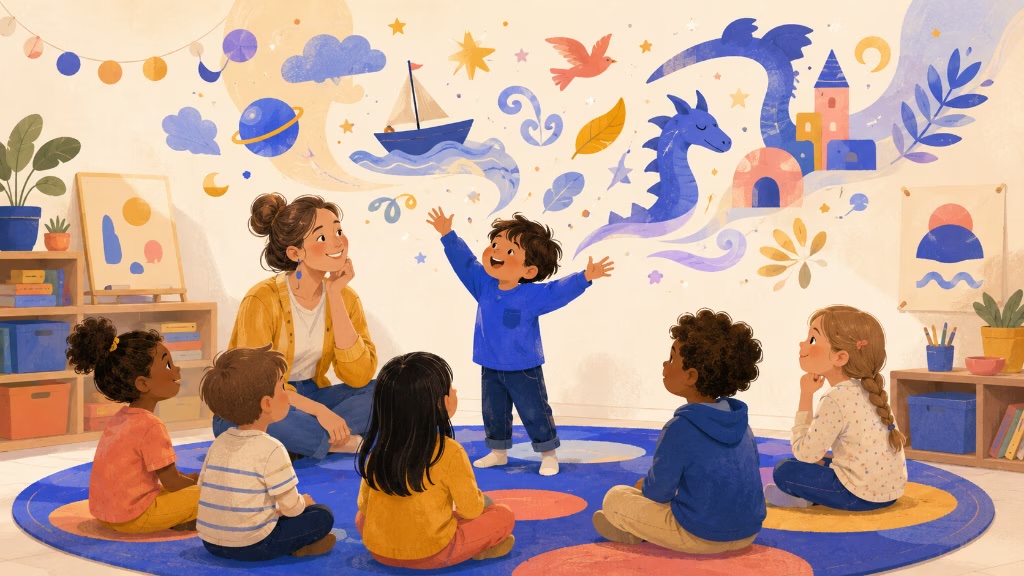
In short — In elementary school, speaking isn't a test: it's a skill under construction. Children speak to learn — telling, explaining, asking — long before they speak to be assessed. What works: short daily routines, play as the great unlocker of speech, and assessment by kind observation, which tracks progress instead of punishing gaps.
Speaking to learn, before speaking to be assessed
In secondary school, speaking becomes an exam: presentations, defenses, oral finals. But everything is decided earlier. A seven-year-old recounting the zoo trip, explaining their mental-math trick to a classmate, asking a genuine question — that child is already laying the foundations of every future presentation.
With young learners, speech is first a learning tool: putting things into words is how thinking gets organized. The classic mistake is to skip that stage and jump straight to the "graded mini-presentation", turning speech into a performance before it has become a reflex. First: talk a lot, often, in safety. Assessment will come — and it will come better.
Short routines: regularity beats duration
What builds oral confidence is not the big annual occasion; it's the small daily one. A few routines that have proven themselves:
- the daily weather report: one child announces the weather, the date, the day's plan. Thirty seconds, a real audience, zero stakes;
- morning show-and-tell: two or three volunteers share something from their life. They learn to tell events in order and to pick what will interest others;
- the mystery object: describe an object hidden in a bag so the class can guess. Precision of vocabulary, trained without anyone noticing;
- the word of the day, the riddle to ask, the sentence to complete…
💡 The golden rule: short, frequent, rotating. Two to five minutes a day, and everyone gets a turn over the weeks — not just the perpetual volunteers.
Telling, explaining, performing: three different kinds of speech
"Working on oral skills" actually covers three distinct moves, which feed each other but aren't learned the same way:
- telling: holding a story together in order, with a beginning and an end. Trained through re-told stories, picture sequences, show-and-tell;
- explaining: making someone understand a method they don't know. The hidden treasure of math and science lessons: "explain to your neighbor how you found it";
- reciting / performing: poems, drama, tongue twisters. This is where voice, articulation and eye contact get their workout — the "how" of speaking.
Rotate all three across the week and every child finds at least one ground where they shine.
Play: the best unlocker of speech
A child who "won't speak" will almost always play. Play shifts the attention: you're no longer speaking in front of the class, you're playing with it. Puppets that "speak for" the shyest, role play (the shopkeeper, the reporter, the museum guide), team tongue twisters, silly debates ("for or against homework on Sundays?")… A playful constraint frees speech far more reliably than "speak up, please".
And for the most reluctant: shrink the audience (speak in pairs, then small groups, then to everyone), allow passing one's turn, and celebrate the first attempt, however tiny. Confidence grows on safety — true at seven as at seventeen, as we also see with nervous students in oral exams.
Assessing without grading: kind observation
Should any of this be assessed? Yes — in the original sense: seeing where each child stands so you know what to offer next. No score, no ranking. Concretely, you observe simple things: do they speak loudly enough? tell events in order? look at their audience? dare to start without help? A handful of such markers is plenty — it's the spirit of competency-based assessment in its most natural form.
The practical challenge is keeping track: with twenty-five children and daily routines, memory won't do. That's a use where SnapJury works as an observation notebook: during the weather report or a short talk, one tap records a success or a point to work on for the child concerned — no rubric, no grade — and over the year those small traces map each child's progress, invaluable on parent-meeting evenings. The feedback itself remains your craft: short, concrete, one success first — the habits of feedback that helps students progress apply from first grade onward.
In summary
Oral skills with young learners means lots of speech, very little test: short daily routines, three moves practiced in rotation (telling, explaining, performing), play as the doorway for everyone, and assessment that observes and encourages instead of scoring. Children who spoke often and safely in elementary school walk into secondary-school presentations with a head start — which is exactly the point.
Frequently asked questions
Should oral work be graded in elementary school?
Not with a number. At this age, oral skills are assessed by observation: you notice what each child can already do (speak up, tell events in order, look at the audience) and what to help them build next. The record is for the teacher, not for ranking.
What speaking routines work in an elementary classroom?
Short, regular ones: the daily weather report, morning show-and-tell, the word of the day, the mystery object to describe. Two to five minutes, almost every day: regularity builds confidence, not duration.
How do you help a child who won't speak in front of the class?
Shrink the audience (pairs, small groups), go through play — a puppet that speaks for them works wonders —, allow them to pass their turn, and celebrate the first attempt however tiny. Confidence grows from safety, never from pressure.
Can SnapJury be used with young learners?
Yes, as an observation notebook: during a routine or a short talk, the teacher taps once to record a success or a point to work on for each child — no rubric, no grade. Over the year, those small traces map out each child's progress.
Try SnapJury free for 7 days, no credit card.
Download on the App Store